Brain Organoids

(Page 34) The “brain in a vat” theory is a philosophical thought experiment, proposing a disembodied human brain connected to a computer that simulates all the electrical impulses that the human brain would have naturally. Would this brain be able to tell it was not in a real body? The idea provokes speculation on what consciousness is and the requirements for it, and has been explored in an array of popular media. The Matrix (1999) famously takes this as its premise: a dystopian society that is actually a simulation controlled by superintelligent AI. All inhabitants are hooked up to the Matrix, which feeds their brains a false reality. While such technology hasn’t been developed yet–unless we really are unknowingly in a simulation–the idea of disembodied brains isn’t relegated to science fiction. Since the development of human brain organoids in 2013, scientists have quite literally been growing brain cells in the lab.
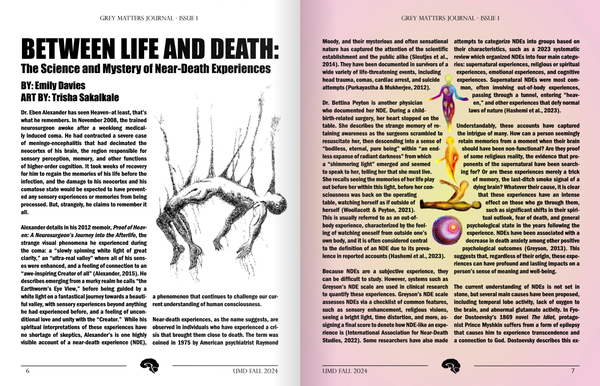
Between Life and Death: The Science and Mystery of Near-Death Experiences

(Page 5) Dr. Eben Alexander has seen Heaven–at least, that’s what he remembers. In November 2008 the trained neurosurgeon awoke after a weeklong medically induced coma. He had contracted a severe case of meningo-encephalitis that had decimated the neocortex of his brain, the region responsible for sensory perception, memory, and other functions of higher-order cognition. It took weeks of recovery for him to regain the memories of his life before the infection, and the damage to his neocortex and his comatose state would be expected to have prevented any sensory experiences or memories from being processed. But, strangely, he claims to remember it all.

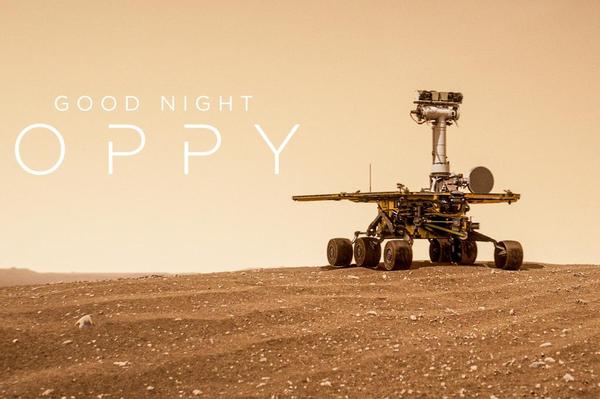
Review: ‘Good Night Oppy’ chronicles the life and journey of two Mars rovers

The personification of robots has long held an allure in the public imagination. From WALL-E to R2-D2 to Star Trek’s Data, the media has latched onto projecting human traits and personalities onto artificial intelligence. As Amazon’s recent documentary Good Night Oppy reveals, NASA missions are no exception to this. 
The documentary explores our relationship to machines in the context of the 2003 Mars Exploration Rovers, Spirit and Opportunity — the latter of which was fondly christened “Oppy” b...

Is lab-grown meat the future of animal agriculture?

Depending on who you ask, the act of eating meat may be a controversial one.
Though humans have long derived food from domesticated animals, such as cows, pigs and chickens, the 21st century has seen a rise in vegetarianism and veganism.The diet’s popularity has led to trends such as Veganuary — a monthlong challenge to abstain from animal products. According to data from 2021, the most popular motivation for participating in Veganuary was a concern for animals; other causes included environment...

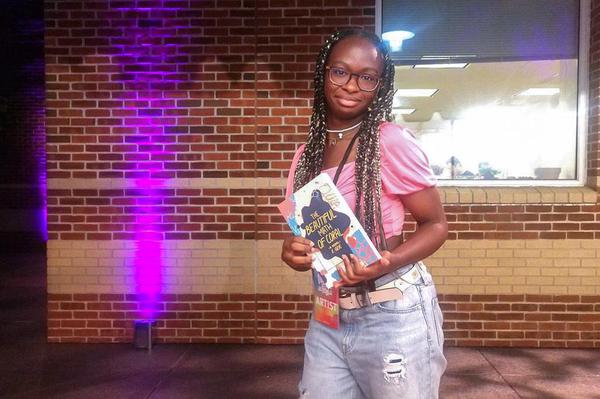
UMD student’s novel shows art and science don’t need to be separate

STEM versus the arts: It’s a seemingly clear-cut dichotomy that many of us feel forced to choose between the wonders of literature and music or cell biology and engineering.

Ijeoma Asonye, a junior mechanical engineering major at the University of Maryland, knows this all too well — and she’s written a novel about it. The Beautiful Math of Coral, published in 2021, explores the relationship of STEM and the arts with the human experience.

Asonye began work on the book in May 2020, and eventuall

With BookTok, reading doesn’t have to be a solitary activity

For better or worse, TikTok has become a social media force to be reckoned with in the past couple of years. Though the site has had its fair share of controversy, it remains one of the most popular online platforms for Generation Z and last year became . TikTok’s appeal lies in its accessibility, entertainment value and the variety of subcultures that have developed on the app. One such subculture is BookTok.

Reading centered subcultures have long existed on other platforms — BookTube (Book Yo

Art-ificial Intelligence: The future of artistic expression

Pop culture has long viewed artificial intelligence through a somewhat paranoid lens, with movies such as The Terminator, The Matrix and 2001: A Space Odyssey speculating darkly about the possibility of ultra-intelligent computers turning against their creators. Although there’s still a bit more ground to cover before we really run the risk of any sort of machine takeover, 2022 has brought a plethora of fascinating new technologies to the scene, and it’s become clear AI is a field to watch.

Rec